7 February 2026
6 min read
The reality of foreign-owned workplaces in Africa
Foreign investment across Africa brings real jobs and real skills — and real hardship. An honest look at both sides, and why the debate that matters is about power and accountability, not nationality.


Gershon Otinkorang
IT Support Specialist
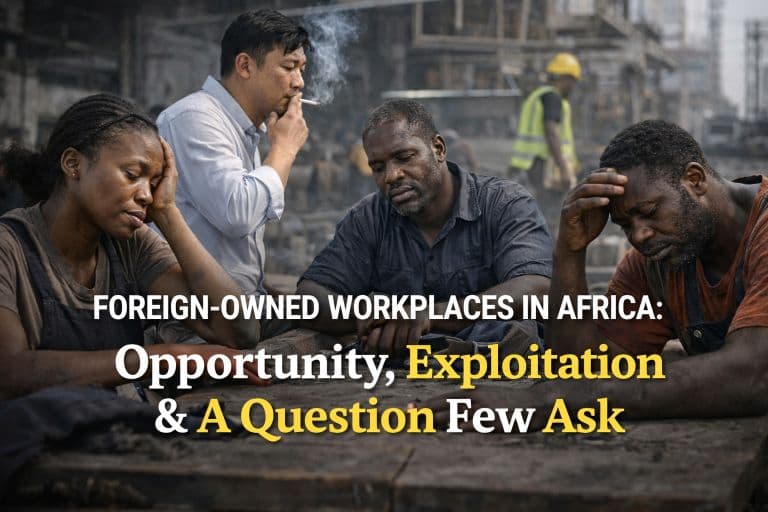
Foreign investment is reshaping work across Africa. Walk through almost any African city and the signs are everywhere — new factories, construction sites, industrial parks, logistics hubs, export zones — much of it owned or managed by investors from China, India, Lebanon, Europe, and the United States. Millions of Africans now work under foreign management every day.
Ask them how it feels, and you often hear two things in the same breath:
"This job opened doors for me."
"This job nearly broke me."
Both can be true at once. That contradiction is exactly why this is worth talking about honestly.
The part people don't say loudly: the benefits are real#
Credit where it's due. Across construction, manufacturing, mining, retail, and telecoms, many Africans say foreign-managed workplaces helped them grow in ways they didn't expect.
Real jobs, real exposure. For a lot of young people, these companies are the first genuinely serious workplace they enter — structured operations, targets, reporting lines, systems that look like global business. Large surveys, including McKinsey's study of Chinese economic engagement in Africa, found that many foreign-owned firms employ mostly local workers and provide on-the-job training.
Practical skills over theory. People learn by doing — equipment handling, project delivery, quality control, procurement, logistics discipline, sometimes even basic automation. It is the kind of competence a classroom rarely gives you.
A culture of speed and execution. Some foreign-run environments move fast, and workers describe learning to deliver under pressure, hit deadlines, and work to real performance expectations.
So yes — there is opportunity here, and many Africans build strong careers on it.
The part that keeps coming up: heavy work, unfair systems#
Now the harder side — the complaints that recur across countries and industries, in worker conversations and in reporting.
Schedules that ignore human limits. The common theme is "always on": weekends treated as ordinary workdays, public holidays worked through, leave that is vague, discouraged, or applied inconsistently. Not every company does this — but where it happens, workers describe it as exhausting, and it drives high turnover.
Role drift — hired for one job, responsible for five. This one is everywhere in industrial parks and fast-growing companies. Someone is hired for a defined role and slowly becomes the solution to everything: IT, admin, procurement, project oversight, operations. From the outside it looks like growth. From the inside, it often feels like the unpaid expansion of responsibility.
Respect, and the stereotypes underneath it. How local staff are spoken to — tone, trust, dignity — keeps resurfacing. Some workers report being addressed harshly, treated as inherently suspect, or seen as replaceable. When respect is missing, even a good salary can feel like a bad deal. Several countries have seen public labour disputes and formal complaints tied to allegations of discriminatory treatment — not universal, but common enough to keep reappearing.
Safety and welfare gaps. In heavier industries — mining, construction, factories — workers raise concerns about PPE, safety procedures, medical support, and how incidents are handled. Human-rights reporting has documented serious allegations at specific sites: Human Rights Watch's investigation of Chinese state-owned copper mines in Zambia, for instance, detailed persistent safety failures, punishing shifts, anti-union pressure, and threats against workers who refused to work in unsafe places underground.
Culture gaps that harden into conflict. Even where no one means harm, differences create friction: direct versus indirect communication, orders versus collaboration, language barriers, mismatched assumptions about local labour law. A study of manufacturing firms around Addis Ababa found labour conflict running higher in foreign-owned firms — and highest of all in Chinese-owned ones — even where pay and conditions matched domestic firms, with clashing assumptions about the role of local labour law a recurring driver.
What leaders normalise, spreads#
There is a quieter point workers raise: unhealthy behaviour becomes "normal" when it happens openly — especially when senior staff do it. A frequently cited example is smoking in and around work areas. Beyond the health risk, it signals that the rules don't really apply. In already-stressed environments, that logic spreads fast:
If leadership can do it openly, why should anyone else hold back?
At its worst, workers link it to a broader slide in discipline and safety, including rising substance misuse on site. This is not about any one nationality — it is about what leadership models and what enforcement allows.
The nationality debate might be the wrong argument#
Online, this discussion usually collapses into one question: "Is it a Chinese problem?"
Zoom out, and a more useful one appears: is it a power-and-accountability problem — one that can surface under any foreign-owned company where labour systems are weak and workers have little protection?
Because the same stories show up, in different forms, across many foreign-run settings: delayed wages, harsh supervision, discrimination, unsafe conditions, thin HR. And exploitative practice is not unique to Africa — global labour investigations have surfaced it across many countries and supply chains, including inside China itself. If the problem is bigger than one group, blaming one nationality is simply too small an answer.
What should change — without scaring off investment#
Africa needs investment. Africa also needs dignity. It should not have to choose between them. A few standards ought to be non-negotiable, whatever the sector or the owner's passport:
- Contracts that match the real expectations of the job
- Leave policies that exist in practice, not just on paper
- Health and safety that is actually enforced — including on smoking and substance risk in work zones
- Workplace respect treated as a KPI, not a suggestion
- Labour inspections that carry consequences, not just warnings
- HR systems built to protect both productivity and people
The research keeps landing on the same conclusion: where enforcement is weak, bad practice grows — regardless of who owns the business.
The question I'll leave you with#
From what you have seen — your own work, your friends, your community — do these problems show up mainly in Chinese-managed workplaces? Or do they show up anywhere power is unequal, labour standards are weak, and workers feel replaceable — whether the company is Chinese, Indian, Lebanese, European, or American?
Answer that honestly, and we can stop arguing about labels and start fixing systems.
When two elephants fight, it is the grass that suffers.
Too often, in the fight between profit and accountability, the workers are the grass.
If you have lived this — as a worker or as a manager — I would like to hear it. You can reach me through the contact section.
Read next
2 August 2026 · 2 min
Two ID cards per A4 sheet, straight from ERPNext
A print format that turns ERPNext employee records into finished, front-and-back staff ID cards — two to a sheet — with no external design tool in the loop.
1 August 2026 · 2 min
Your network is slow, and it's probably not the fibre
A short field note on why latency complaints in a large network almost never point at the fibre — and the order I actually check things in.